Haven town hall clock tower
The TommyknockersHaven town hall clock tower is both the town’s administrative landmark and the setting for Ruth McCausland’s desperate attempt to send a signal beyond Haven. She plants electronic devices inside dolls and arranges them in the tower’s attic; when the clock mechanism strikes, the tower bursts open, rises on cold green fire, and explodes. Its destruction marks the conversion of a familiar civic structure into a beacon of the town’s hidden crisis—and a danger reaching beyond its borders.
Civic Landmark and Hidden Interior
The town hall stands as a place of public administration, but the tower above it holds another kind of power: a clock whose machinery continues to turn amid bats and years of deferred maintenance. Its single clock face, twelve feet in diameter, overlooks Main Street; behind it, wheels and cogs move toward a hammer that strikes a bell. The dent in the bell is deep and ancient. In the attic, the clock’s ordinary mechanism becomes the instrument through which Ruth’s devices will act.
The structure also contains Haven’s documentary memory. The town’s records fill the two rooms at the top of the building, preserving names the settlement once bore, including Ilium, Montgomery, Coodersville, and Montville Plantation. As Ruth approaches the tower, the contrast between those records and the danger gathering in the present makes the town hall more than a backdrop: it is at once the town’s administrative brain, its paper memory, and the site where its concealed condition becomes physically visible.
Ruth’s Ascent and the Signal
After deciding that a signal is all she can still send, Ruth makes her way to the town hall with a duffel bag of dolls. The climb costs her dearly. Dragging the bag through the building and up three flights, she loses teeth; hauling it into the attic, she cuts her arm with the cord and bleeds from her gums and ears. The tower’s cramped, shadowed interior encloses the effort, while the loud clockwork and the sleeping bats make the attic feel both active and abandoned.
Ruth opens the duffel and places the dolls in a circle, their feet touching and their hands likewise joined. Each doll has been opened and sewn back together around a small device made from C-cells, wires, electronic-calculator circuit boards, and a cardboard toilet-paper core. The core is intended to channel the force the devices generate. Ruth does not fully understand how she knew to construct them; the knowledge seems to have come to her without a clear source. Her improvised signal therefore bears the mark of Haven’s transformation even as she turns that transformation against the town’s confinement.
She attaches an M-16 to the dented center of the great bell, arranging the weapon so that the clock’s hammer will strike it. The final mechanism is an uneasy fusion of municipal timekeeping, household materials, and a firearm. The tower is no longer simply a place from which the town announces the hour: Ruth has made its bell and clockwork part of a device intended to attract attention beyond Haven.
The Explosion and Its Reach
At 3:05 p.m., the tower’s base bursts apart, spraying powdered brick. The explosion breaks nearly every window in Haven and many in nearby Troy and Albion. Green fire pours through the breach, lifting the tower like a brick missile on a pillar of cold flame. The fire does not consume the dolls or Ruth’s arm, and the tower rises while its sides begin to bulge outward.
For a moment, the impossible ascent retains the recognizable shape of a clock tower, with its face still set into the rising masonry. Through the explosion’s roar, the clock keeps striking hour after hour. At the twelfth stroke, the tower blows apart. Bricks punch through houses, cellar windows, and board fences; the clock’s long wrought-iron hand crosses the air and embeds itself in an ancient oak outside the Haven Library. The violence thus extends beyond the town hall itself, scattering fragments of its machinery across Haven and making the tower’s destruction a town-wide event.
From Town Landmark to Disaster Signal
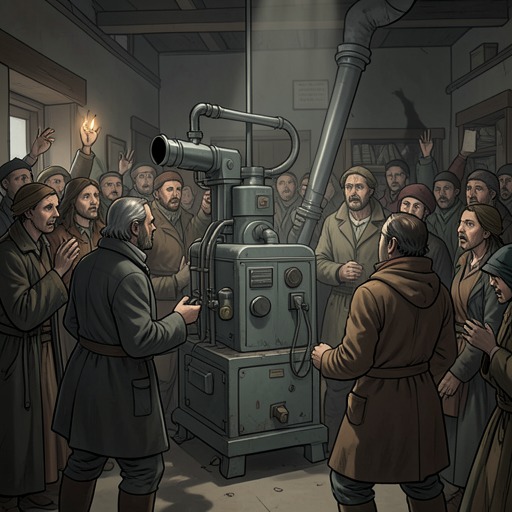
The explosion is immediately followed by an extraordinary communal response. The changed residents coordinate as a network of silent voices, and within forty-five minutes roughly seventy people have gathered at Henry Applegate’s workshop. They share information and plan what must be built next, showing that the tower’s destruction has not broken the mental link that Ruth feared. It has instead made the crisis impossible to keep within the tower—or within the town’s ordinary institutions.
By nightfall, the National Guard has surrounded Haven, with those downwind wearing oxygen equipment. State troopers Claudell Weems and Andy Torgeson escape on foot after abandoning their disabled cruiser, exchanging the oxygen from their last flat-pack as they walk into Troy. Their account becomes the first official report of what is happening, following hundreds of unofficial reports about lethal air and a gigantic UFO rising from the smoke in Big Injun Woods. The ruined clock tower stands at the hinge between the local and the public: a failed civic structure turned into a spectacular warning, after which Haven is treated as a contaminated zone and sealed off from the outside world.